Key Takeaways
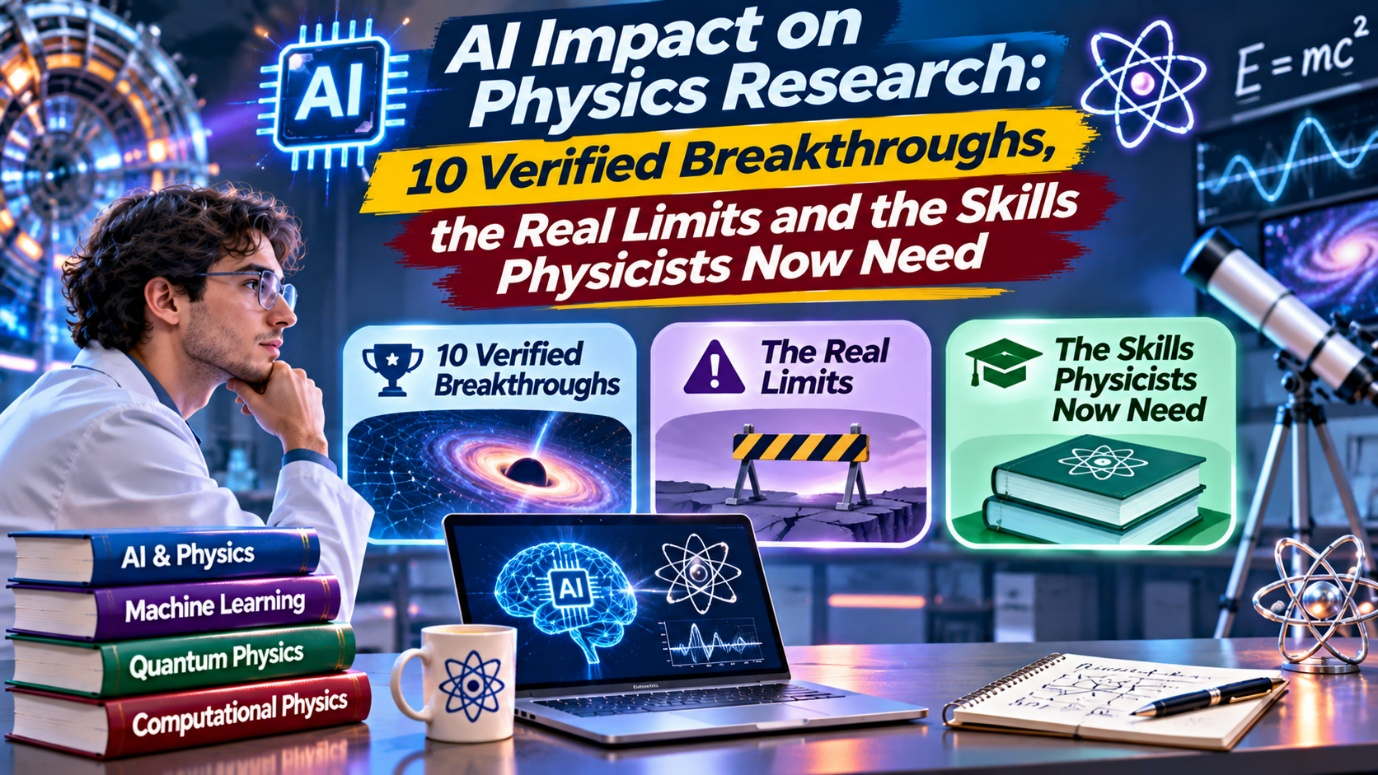
- Today, practical systems show a tangible AI impact on physics research across particle accelerators, fusion research experiments, gravitational-wave research, and weather forecasting.
- It has the most promising applications in data processing, simulation and experimental control.
- AI’s scientific discovery potential is promising, but many claims need independent validation.
- Problems with reproducibility in machine learning, uncertainty, interpretability, and computing cost remain major issues.
- Physics students should learn to program, use statistical tools, apply machine learning, and communicate scientific information.
Introduction
Artificial intelligence (AI) has been integrated into all fields of science, reducing time-consuming activities and delivering faster results, highlighting the AI Impact on Physics Research. It has influenced the analysis of vast quantities of information, the speeding up of simulations, the control of experiments, and the detection of patterns that could not be found by traditional methods. We can see this active AI impact on physics research in everyday operations. Software filters high-rate collisions at CERN in nanoseconds, stabilises burning tokamak plasma, and flags binary neutron star mergers within a single second. In addition, John Hopfield and Geoffrey Hinton were awarded the 2024 Nobel Prize in Physics AI for key discoveries and inventions that paved the way for machine learning with artificial neural networks. Many physics students struggle to turn complex computer experiments into clean essays or lab reports. If you find it hard to format technical arguments, you can check out academic writing services from The Academic Papers UK to see how model papers organise difficult topics. This guide cuts through the hype to look at ten real breakthroughs, the limits of current tools, and what students actually need to learn.
How Is AI Actually Used in Physics Research?
When we study the practical AI impact on physics research, four specific tasks account for almost all successful applications:
- Data analysis: Machine learning in physics focuses on abnormal patterns in particle collisions and astronomical observations.
- Simulation: Approximate physically expensive simulations.
- Experimental control: Reinforcement learning adjusts the magnetic fields and other experimental parameters.
- Scientific discovery: Symbolic regression or generative models can help the researchers study equations, materials and experimental designs.
The Evidence Ladder: How to Evaluate Claims for AI in Physics
Not every public announcement about AI physics research carries equal weight when evaluating the overall AI Impact on Physics Research. While reading a paper, literature review, or press release, assign the findings to an evidence tier:
- Operational Deployment: Systems actively used in actual experiments or operational scientific services (e.g., CMS trigger and ECMWF AIFS).
- Peer-Reviewed Research: Findings published in reputable scientific journals after rigorous peer evaluation (e.g., DINGO-BNS and AI Feynman).
- Contested Research: Published findings actively challenged or debated by external researchers in the field (e.g., GNoME materials predictions).
- Preprint or Benchmark: Results available for community scrutiny that have not yet completed full peer review (e.g., CritPt physics benchmark).
- Developer Claim: Announcements made directly by the organization developing the AI prior to external verification (e.g., OpenAI’s 2026 gluon-amplitude result).
Note: Not all peer-reviewed papers have strong conclusions, and an operational system does not necessarily represent a new scientific discovery. When evaluating a colleague’s work, focus on independent validation, reproducibility, and the limits of AI impact on physics research.
10 Verified Breakthroughs Demonstrating the AI Impact on Physics Research
1. Particle Physics: Filtering Collisions at CERN (Operational)
For the proton collisions, the Large Hadron Collider (LHC) delivers around 40 million events per second. It would not be feasible to store and analyse all collisions. For this purpose, an anomaly-detection neural network called AXOL1TL is used in the CMS experiment and is embedded into the CMS trigger system, Level-1. It detects abnormal collision sequences within about 50 cycles at 100 million fps using dedicated FPGA-based hardware. However, in 2024, more than 4 billion collisions were selected using anomaly detectors, and approximately 740 million of them were not recorded by other triggers. This is an operational example of AI at CERN and AI in particle physics, capturing rare, unmodeled events that traditional hand-crafted rules would have missed entirely.
2. Particle Physics: Improving Particle Identification (Peer-reviewed)
AI also impacts the identification of particles created during high-energy collisions. For this purpose, the ATLAS experiment has created a new Transformer-based jet-flavour tagging algorithm, GN2, which was published in Nature Communications in January 2026. It uses particle tracking data to separate jets based on the type of quark that created them. In this experiment, physics-informed training objectives were used to improve classification and enable more accurate particle measurements. This application shows how deep learning physics methods clean up raw signals and tighten parameter errors.
3. Fusion Research: Controlling Plasma (Experimental demonstration)
AI’s contribution to physics research is significant in controlling plasma during experimental demonstrations. Accurate control of the very hot plasma in fusion experiments is achieved with magnetic fields. In 2022, Google’s DeepMind scientists and EPFL scientists demonstrated an AI fusion plasma control architecture on the TCV tokamak in Switzerland. A deep reinforcement learning agent adjusted nineteen magnetic coils at 10 kHz, maintaining stability across multiple shapes and holding two distinct plasma droplets simultaneously. This demonstration proved that AI fusion research can manage complex fluid instabilities better than conventional rigid controllers.
4. Gravitational Waves: Faster Signal Analysis (Peer-reviewed)
AI is also used for faster signal analysis, where gravitational waves are used to study neutron stars and black holes. But understanding highly complex signals can be very demanding in terms of computing power. In March 2025, the DINGO-BNS machine learning model was published in the journal Nature, enabling binary neutron star inference in about a second. The project demonstrates the speed of machine learning gravitational waves analyses, pinpointing sky coordinates roughly 30% more precisely than BAYESTAR. Rapid localisation lets optical telescopes pivot immediately toward the target to catch short-lived kilonova light.
5. Weather Forecasting: AI Models in Operation (Operational)
Predicting the atmosphere is an applied problem in planetary fluid dynamics. . In 2023, DeepMind released its model called GraphCast in Science, which highlighted the capabilities of machine learning in weather forecasting at a global scale. The successor to this, GenCast, which was published in Nature in 2024, surpassed ECMWF’s ensemble forecasting system for 97.2% of 1,320 targets tested. The European Centre for Medium-Range Weather Forecasts (ECMWF) rolled out its Artificial Intelligence Forecasting System (AIFS) into operations in February 2025. Based on a selection of forecasts, ECMWF said it improved its forecasts by up to 20% and noted “significant” reductions in energy use per forecast. Modern AI weather forecasting models and wider AI weather forecasting platforms cut supercomputer energy consumption by orders of magnitude while predicting tropical cyclone tracks with improved accuracy.
6. Discovering Equations Through Symbolic Regression (Peer-reviewed)
AI’s contribution also includes symbolic regression physics tools, an attempt to discover an equation that describes numerical data. Scientists released the physics-based artificial intelligence algorithm, AI Feynman, in 2020. All 100 equations that have been tested in the Feynman Lectures on Physics were recovered successfully. It was also shown to boost the success rate for a more difficult physics dataset from 15% to 90%.
7. Designing Quantum Experiments (Peer-reviewed)
In 2016, researchers studied experimental study design to generate complicated quantum states and developed an algorithm called MELVIN. In 2016, researchers studied setups that can generate complicated quantum states and found an algorithm called MELVIN, which searches for such setups. Therefore, researchers have published in Physical Review Letters and emphasised that AI-based algorithms are effective for finding novel ways to perform quantum optics experiments.
8. Condensed Matter: Many-Body States and Lattice Gauge Theory (Peer-reviewed)
Understanding interactions between large numbers of quantum particles is one of the major challenges in theoretical physics. In 2017, Carleo and Troyer demonstrated that variational neural network physics architectures could accurately approximate many-body wavefunctions. In 2020, researchers used machine learning-based normalising flows in lattice gauge theory. This AI helps physicists to calculate outcomes.
9. Materials Discovery: The GNoME Debate (Contested research)
Screening functional crystals is another common test for AI for science. DeepMind introduced GNOME in Nature (2023), predicting 2.2 million crystal variations and highlighting 380,000 stable candidates. In 2024, Anthony Cheetham and Ram Seshadri argued in Chemistry of Materials that very few of these proposed structures were novel, chemically credible, and practically synthesisable. DeepMind maintained its position, noting subsequent lab syntheses. This debate shows why scientific claims need external chemical and physical validation before they are accepted as established facts.
10. Large Language Models as Theory Assistants (Emerging evidence)
Large language models (LLMs) in physics can assist with literature searches, coding, mathematical explanations and preliminary theoretical investigations. The following are three developments that should be focused on while using AI;
- CritPt benchmark: A benchmark of 71 research-level physics challenges, developed by over 50 physicists, was published as a preprint in 2025. It was initially identified as having significant challenges for general-purpose AI.
- Research assistance: AI can help with coding, literature review and calculations, but the results must be checked by experts.
- Gluon amplitudes: In February 2026, OpenAI announced that GPT-5.2 suggested a formula for a set of gluon scattering amplitudes, which an internal model and physicists then confirmed.
What Are the Risks of AI in Physics Research?
AI helps physicists sift through large volumes of experimental numbers, but the broader AI Impact on Physics Research brings clear technical risks. In physics, an answer without clear error margins or physical meaning is not very useful. The main risks researchers face include:
- Data leakage and reproducibility: Leakage happens when numbers from your test set accidentally slip into your training data. This makes a model look far more accurate than it actually is. In one review by Princeton researchers, data leakage caused problems across 41 papers, affecting 648 scientific studies. To fix this, you must keep training, validation, and testing files completely separate from day one.
- Unquantified uncertainty: Many neural networks output a single number without an error bar. Physics depends on knowing how confident a result is. Researchers should use calibration tests, ensemble models, or Bayesian methods so they can report real error ranges.
- Domain shift: A model trained only on computer simulations often fails when you feed it messy, real detector data. You must always check your network against real experimental calibration runs before you trust the outputs.
- The black-box problem: Deep neural networks do not show the mathematical logic or steps behind their answers. If a model flags a rare event, you must check if that decision follows known physical laws, like conservation of energy, rather than background electronic noise. Physics-informed machine learning helps solve this by forcing models to respect basic laws.
- Over-claiming: Companies and research groups often issue press releases before independent scientists have checked the code. Treat unexpected announcements as unconfirmed until other labs test and repeat the results.
How Do Physicists Feel About AI? What the Surveys Say
Surveys reveal a scientific community that is both enthusiastic and careful:
- Institute of Physics (IOP 2025): In a study of 700 physicists, 97% recognised tangible benefits from AI, 75% saw clear opportunities for physics discovery, and 66% had used machine learning in their work. At the same time, 90% warned of clear risks, citing black-box reasoning and unverified predictions as their top worries.
- American Institute of Physics (AIP 2025): Roughly 23% of recent physics bachelor graduates and 40% of newly minted PhDs regularly run machine learning tools in their research or industry roles.
- Peer Review Concerns: An IOP Publishing study found that 57% of active researchers strongly object to reviewers using generative text tools to write evaluation reports on submitted manuscripts.
The UK Picture: Funding, Facilities and Policy
The United Kingdom directs significant public capital into computational infrastructure:
- UKRI Strategy: In February 2026, UK Research and Innovation announced a £1.6 billion strategy through 2030, reserving £137 million for AI scientific discovery and £250 million for national cloud facilities through the AI Research Resource.
- Supercomputing Upgrades: The Cambridge DAWN supercomputer secured £36 million in hardware expansions. Meanwhile, the STFC Hartree Centre in Daresbury expanded its GPU installations under a £210 million joint venture with IBM.
Will AI Replace Physicists?
AI is an effective tool in physics research and can support applications such as AI weather forecasting, but it cannot replace physicists because they can critically analyse AI-generated findings. In addition, AI can process data, automate repetitive calculations, and identify patterns. Researchers are responsible for formulating hypotheses, choosing methods, analysing results, and determining whether the results have physical meaning. Academic Papers UK supports students with academic editing so they can improve the quality of their work. Physicists with a solid understanding of their subject and strong computer and analysis skills will benefit from this advantage.
The Skills That Now Matter: A Checklist for Physics Students
To make use of the real AI impact on physics research, undergraduates and postgraduate candidates need specific technical and analytical capabilities:
- Python programming: Physics students must be comfortable programming in Python and explore frameworks like PyTorch or JAX.
- Statistics: Students must know probability, hypothesis testing, uncertainty propagation and model evaluation.
- Machine learning: Students should also develop knowledge of neural networks, supervised learning and reinforcement learning.
- Physics fundamentals: Physics students should focus on the fundamentals of mechanics, electromagnetism, quantum physics and mathematical modelling.
- Research software skills: Students should focus on version control, testing, documentation, and reproducible coding.
- Scientific communication: Students must clearly explain model selection, model assumptions, validation, and limitations.
When drafting complex experimental chapters, reviewing professional guidance on structuring a methodology chapter from The Academic Papers UK can help you present your code validation, control regions, and baseline comparisons clearly for examiners.
How to Write About AI in a Physics Essay or Literature Review
Physics students must focus on the following aspects that should be incorporated when writing an essay about AI in the academic environment, and distinguish between published research and preliminary research.
- Prioritise original research: Students should use journal articles and conference papers, not just news reports.
- Evaluate evidence: Physics students must discuss the reliability of a result based on experimental, peer-reviewed, or unconfirmed evidence.
- Discuss limitations: Students should focus on uncertainty, reproducibility and potential for data leakage.
- Follow academic policies: Students must evaluate and understand the university’s guidelines for using generative AI.
Conclusion
AI has a real place in physics today, underscoring the tangible AI Impact on Physics Research. It helps teams filter raw data, speed up slow simulations, and keep fusion plasma stable. But it cannot replace the person in the lab. A computer model cannot tell you if an answer makes physical sense or if a detector had a hidden error.
If you are working on a physics essay, literature review, or project write-up, explaining your computer methods clearly is just as important as running the code. For students who need help organising a difficult dissertation chapter against UK university standards, reliable essay help services provide practical support and model examples to help you submit clean, solid work.
Frequently Asked Questions
Why did the 2024 Nobel Prize in Physics go to AI researchers?
The 2024 Nobel Prize in Physics went to John Hopfield and Geoffrey Hinton for fundamental discoveries and inventions that made machine learning possible through artificial neural networks.
Can AI discover new laws of physics?
AI can find mathematical relations and reinvent equations that have already been discovered. Finding and testing new physical laws completely is still an open research question.
How is AI used at CERN?
CERN experiments use machine learning to sift through particle collisions, recognise the nature of the particles, and look for unusual events. The AXOL1TL system of the CMS experiment is an example of anomaly detection that is implemented at the Level-1 trigger.
Is machine learning useful for a physics undergraduate project?
Yes. Students can apply machine learning to analyse experimental data, model physical systems, and explore patterns if they have a research question and suitable validation techniques.
What is physics-informed machine learning?
Physics-informed machine learning is a type of machine learning that uses known physics, such as conservation laws and differential equations, in the design or training of a model.
Can I use AI in my physics dissertation?
This varies according to the academic integrity policy of your university. The use of AI may be helpful for coding, data analysis, and literature search, but should be properly credited, and all outputs and scientific conclusions should be reviewed.
Read more: The Digital Shopping Revolution in Britain’s Sports Nutrition Industry