
What is Future of Font Generator Websites?
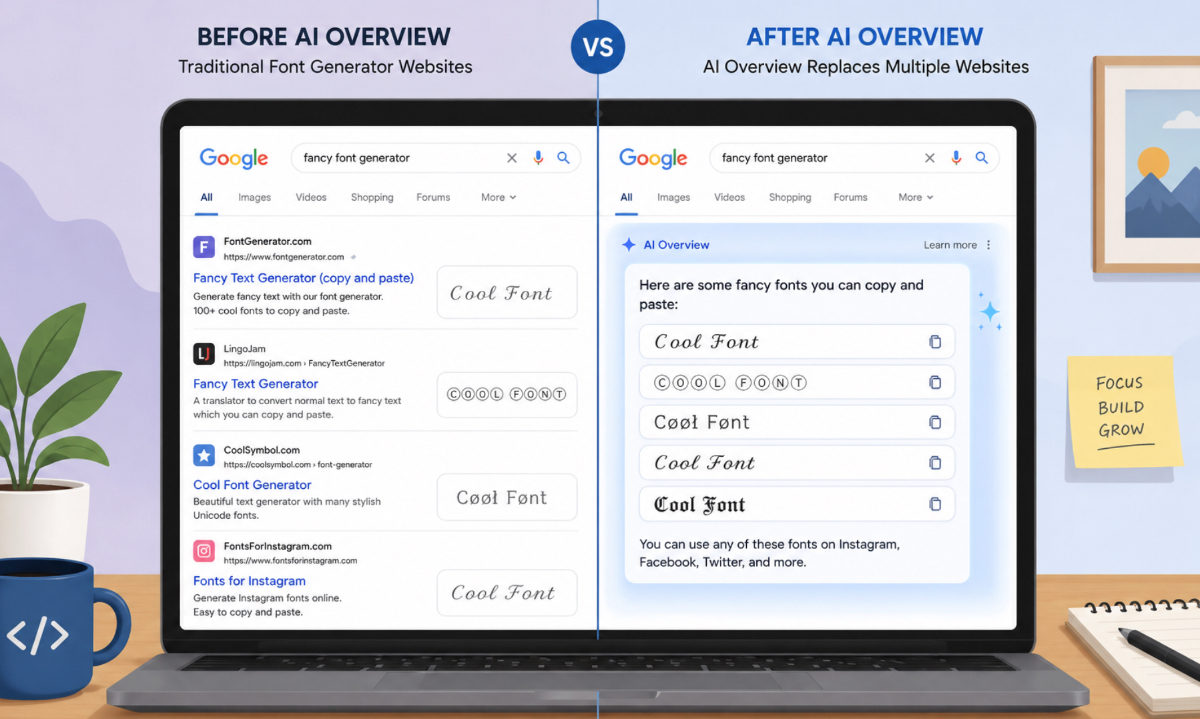
What is the Future of Font Generator Websites?
Font generator websites have been a go‑to for quick stylized text, social media fonts, and design experiments. But the ground is shifting — and fast. The real question isn’t just about new AI tools, it’s about how people will even find those tools in the first place.
🤖 AI is rewriting font creation
AI font generation has exploded. Systems like OneFont understand design intent through dialogue, Fontify creates high‑quality glyphs from a single reference, and tools like Mixfont let anyone generate custom fonts from a text prompt. Even desktop apps like Typogenesis turn handwriting into digital typefaces.
The global font generator market is projected to hit $2.63 billion by 2032 (CAGR 8.3%). So the tech is booming — but that doesn’t guarantee traffic for standalone websites.
📉 The Google threat: AI Overviews = fewer clicks
Google’s AI Overviews (formerly SGE) now generate direct answers right at the top of search results. When someone searches “cursive text generator”, the AI can summarise, show examples, or even mimic the tool — without the user ever leaving Google.
🧠 A French study found generative search pulls more from Google’s own properties than external sources.
⚖️ Publishers have already filed antitrust complaints — traffic to independent sites is shrinking.
Why this hits font generators hardest
Font generators are utilitarian — people want a fast result, copy it, and leave. If Google can offer that same result inside the search page, there’s almost no reason to click through to your site.
🧩 Three ways this plays out
- AI Overviews become the font generator — Google integrates text styling directly into the SERP. No click needed.
- Google prioritises its own tools — its own font widgets or preferred partners appear before organic results.
- Traffic dies, not revenue — AI summaries cite your site, but users never visit, so ad income and subscriptions collapse.
🚀 What font generator websites can do
Survival isn’t impossible — but it requires a complete shift in strategy:
- Become the source AI cites — use structured data, answer questions directly, build authority so you appear in AI Overviews even if clicks drop.
- Move beyond one‑shot tools — add proprietary AI models, deep customisation, or Figma/Adobe integrations that keep users inside your ecosystem.
- Focus on professional & enterprise — brand licensing, team workflows, and font management (think Monotype or Adobe) are growing and less vulnerable to zero‑click searches.
- Adapt to “zero‑click” reality — build browser extensions, embeddable widgets, or API‑first services that work outside the traditional website model.
🔮 Final takeaway
The technology for AI‑powered fonts is advancing faster than ever. But distribution is the real battlefield. Google’s AI Overviews will likely absorb a huge chunk of traffic that used to go to font generator sites. Many will be swallowed into zero‑position results or AI summaries, losing their direct audience.
However, the ones that pivot to depth — enterprise solutions, unique AI capabilities, or deep creative workflows — will survive and even thrive. The market is growing, but the winners will be those who own the experience, not those who rely on a Google click.