Picture an AP reader in June with a stack of essays and a rubric that gives exactly one point for the thesis. Not two. Not partial credit. The point is either there in the opening lines or it isn’t, and the reader usually knows within a few seconds.
That’s not a small-stakes moment. In May 2025, 617,689 students sat the AP English Language and Composition exam, according to College Board’s published score distributions, and every one of them wrote three essays judged partly on that single sentence. The same thing happens, less formally, every time a professor opens your paper. So what separates the thesis that earns the point from the one that doesn’t? Graders are surprisingly consistent about it.
Start With a Draft You Can Argue With
Most weak theses aren’t wrong. They’re just unfinished. The writer stopped at the topic (“social media and teenagers”) instead of pushing on to a claim about it.
The fastest fix is to get a rough claim on the page, then attack it. Some students do this on paper with a question and a one-line answer. Others use a Thesis Generator to produce two or three starting versions in seconds, then pick the one worth fighting over. Phrasly’s version asks who your audience is and handles argumentative, analytical, expository and narrative essays, which helps because the right shape depends on the assignment. Either way, treat the first draft as raw material. The real work is the testing that comes next.
What Graders Actually Reward
College Board publishes its scoring guidelines, and they’re one of the clearest public descriptions of what a passing thesis looks like. Strip away the exam language and three ideas remain.
A Position Someone Could Reasonably Dispute
The rubric awards the point for a “defensible position.” It specifically withholds it when the intended thesis states an obvious fact instead of making a claim that needs defending. “Climate change affects agriculture” is true. Nobody needs convincing. “Drought insurance subsidies are doing more to protect farm incomes than new irrigation spending” is a claim. Someone could push back, and that’s the point.
An Answer to the Question That Was Asked
Here’s the trap that catches a lot of capable writers. The guidelines say a thesis that only restates the prompt, or one that doesn’t respond to the prompt at all, earns nothing. Paraphrasing the question in fancier words feels like progress. It isn’t. Your thesis has to commit to an answer.
A Line of Reasoning, If You Can Manage It
College Board notes that a thesis may establish a line of reasoning that structures the essay, though it doesn’t have to in order to earn the point. In practice, the strongest theses hint at the “because.” Readers relax when they can see where you’re headed.
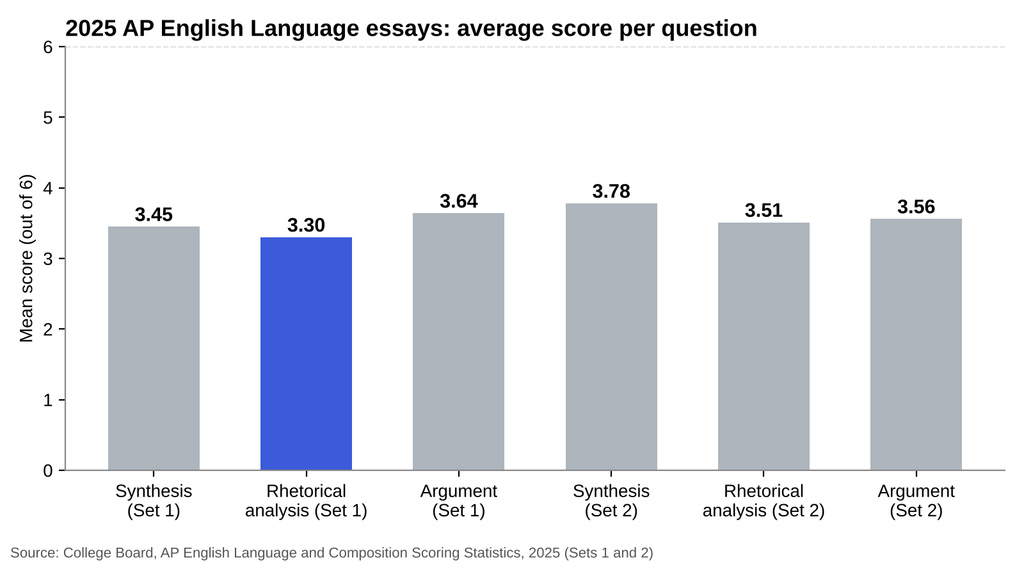
Average scores on the 2025 AP English Language free-response questions, out of 6 points each. Source: College Board scoring statistics, 2025.
Those averages sit between 3.30 and 3.78 out of 6 across both 2025 question sets, per College Board’s scoring statistics. The thesis is only one of those points, but it’s the one that sets up everything else. An essay with no clear claim struggles to earn the evidence and commentary points that follow, because there’s nothing for the evidence to support.
Weak and Strong Versions, Side by Side
It’s easier to see the difference than to describe it. Here are five common failures and what a revision looks like.
| Problem | Weak version | Stronger version |
| Restates the prompt | This essay will discuss whether school uniforms are a good idea. | School uniforms reduce visible income gaps between students, but they do little to curb bullying, which mostly happens online. |
| Obvious fact | Exercise is good for mental health. | Short daily walks do more for student anxiety than weekly gym sessions because consistency matters more than intensity. |
| Too broad | Technology has changed education. | Recorded lectures have helped working students more than any other campus technology since 2020. |
| Summary, no claim | The novel follows a family through three generations. | The novel treats inherited land as a curse, not a gift, and each generation’s choices prove it. |
| Two arguments at once | Remote work boosts productivity and cities should fund more parks. | Remote work boosts productivity for focused tasks but weakens mentoring for new hires. |
Notice what the stronger versions have in common. They narrow the scope, they take a side, and most of them include a reason or a limit. None of them is longer than about 25 words.
Four Quick Tests Before You Commit
You don’t need a rubric to check your own thesis. These take about two minutes.
The “So What” Test
Read your thesis aloud and ask, “So what?” If the honest answer is a shrug, the claim is too safe. Push until the sentence says something a reader might not already believe.
The Disagreement Test
Can you picture a smart person arguing the other side? If not, you’ve written a fact. If you can picture them easily, good. Your essay now has a job: answer that person.
The Roadmap Test
Cover the rest of your essay and look only at the thesis. Could a classmate guess roughly what your body paragraphs will cover? If they’d be lost, add the “because” or the key limit.
The Fit Test
Check the thesis against what you actually wrote. Drafts drift. A thesis written on Monday often doesn’t match the paper you finished on Thursday, and graders notice the mismatch fast. Revise the thesis last, not first.
One Thesis, Three Drafts
Here’s what that testing looks like on a real topic. Say the assignment asks whether high schools should start later in the morning.
Draft one: “School start times are an important issue for students.” It fails the disagreement test immediately. Nobody argues that start times are unimportant.
Draft two: “High schools should start later because teenagers need more sleep.” Better. There’s a position and a reason. But it’s broad, and the reason is so familiar that a grader has read it a hundred times this week.
Draft three: “High schools should move first period to 8:30 a.m. or later, because the gains in attendance and alertness outweigh the cost of rescheduling buses and after-school sports.” Now there’s a specific proposal, a reason, and a nod to the strongest objection. The body paragraphs practically outline themselves: attendance, alertness, then the logistics argument and why it doesn’t win.
None of these drafts took long to write. The improvement came from asking hard questions of each one, which is a habit, not a talent.
How Long Should It Be, and Where Does It Go?
Usually one sentence, sometimes two. AP scoring notes allow a thesis to span more than one sentence if they sit close together, and many college writing centers say the same for longer papers. The traditional spot is the end of your introduction, mostly because readers expect it there. You can break that convention, but you’d better have a reason.
Research papers stretch these rules a bit, since the thesis has to carry a larger argument and often a qualification. If that’s what you’re working on, this guide to writing a thesis statement for a research paper walks through templates and examples built for longer projects.
One more thing. Don’t fall in love with your first phrasing. Writers who get high marks tend to rewrite the thesis three or four times, tightening a word here, cutting a hedge there. It’s tedious. It also works.
One Sentence, Then Everything Else
A strong thesis isn’t clever wording. It’s a commitment: a clear answer to the question, a position someone could challenge, and a hint of how you’ll defend it. Graders reward exactly that because everything else in the essay depends on it.
So start rough. Get a working claim down by hand or with a generator, run it through the four tests, and revise it once the body paragraphs are done. If it survives the “so what” question and still matches your evidence, you’ve got the sentence that earns the point, and probably the paper too.
Read More : How Technology Is Transforming Modern Journalism